



 Mohsin Lag
Solo Leveling didn’t just succeed — it changed what people expect from a power fantasy. The manhwa turned “the weakest hunter alive becomes the strongest” into a global phenomenon, and the A-1 Pictures adaptation did the rare thing: it lived up to the source material, panel for panel, fight for fight. If you’re new to the series, mid-binge, or just trying to understand why half the internet knows what “Arise” means, this guide covers everything — the power system, every major shadow, the anime’s current status, and where to watch it.
One promise before we start: the spoiler-heavy stuff is clearly marked, and you can skip it cleanly. The guide is structured so newcomers and caught-up fans both get something.
What Solo Leveling Actually Is
The story began as a Korean web novel by Chugong, which became the manhwa illustrated by DUBU (Jang Sung-rak) at Redice Studio — the version most fans know, and one of the most-read comics on the planet. The anime, produced by A-1 Pictures (the studio behind Sword Art Online and 86), premiered in January 2024 and immediately became one of the most-watched anime of its year.
The premise is built on a single question the genre had been dancing around for years: what if the power fantasy was the entire point, executed without apology? Ten years before the story starts, gates began opening around the world — portals to dungeons full of monsters — and some humans awakened as hunters with superhuman abilities. Most hunters are born with a fixed rank and never grow stronger. Sung Jin-Woo, an E-rank hunter so weak people call him “the world’s weakest,” survives a double dungeon that should have killed everyone — and wakes up connected to a System that lets him do the one thing no other hunter can: level up. No ceiling. No cap. Just the grind.
The Power System, Explained
Solo Leveling’s rules are simple enough to explain in a paragraph, which is exactly why they work.
- Ranks: Hunters are graded from E (weakest) to S (strongest), measured by mana. Above S sits the rarer-than-rare National Level — hunters recognized for clearing S-rank gates, of which only a handful exist worldwide.
- Gates and dungeons: Portals spawn randomly, rated by the same scale. A gate left open too long “breaks” — the monsters come out. Every arc’s tension comes from this timer.
- The Hunter’s Association: The government body that manages gates, issues licenses, and assigns raid teams. Its chairman, Go Gun-Hee, is one of the most quietly important characters in the story.
- The System: The exception to every rule above. Jin-Woo’s System hands him daily quests, punishes failure with a penalty zone, and rewards completion with stat points — and it only ever interfaces with him.
The genius of the setup is how legible it makes power. When Jin-Woo levels up, you can feel it. When a rank gap gets crossed, the story shows you the math. It’s a system designed for satisfying escalation, and it never loses track of its own rules.
Jin-Woo’s System: The Grind Nobody Else Gets
Everything in Solo Leveling flows from one choice the story makes early and never breaks: Jin-Woo is the only person who can grow. Every other hunter is born with a rank and dies with it. That single rule is what turns his story from a power fantasy into a thriller — because while everyone else is stuck, Jin-Woo is compounding.
The System’s mechanics, in order of appearance:
- Daily Quests: Push-ups, running, training — mundane tasks with lethal penalties for skipping them. The early episodes are a horror story about discipline, and they’re the best part of the show’s setup.
- The Penalty Zone: Fail a quest and you’re dragged into a desert dimension to survive against monsters. It’s where the series teaches you its stakes aren’t cosmetic.
- Stat Points and Skills: Every level means decisions — strength, agility, perception. The show lets you watch the build take shape.
- The Job Change Quest: The turning point. Forced to survive a gauntlet alone, Jin-Woo emerges as a Necromancer — and the “solo” in Solo Leveling stops being a weakness and becomes an army.
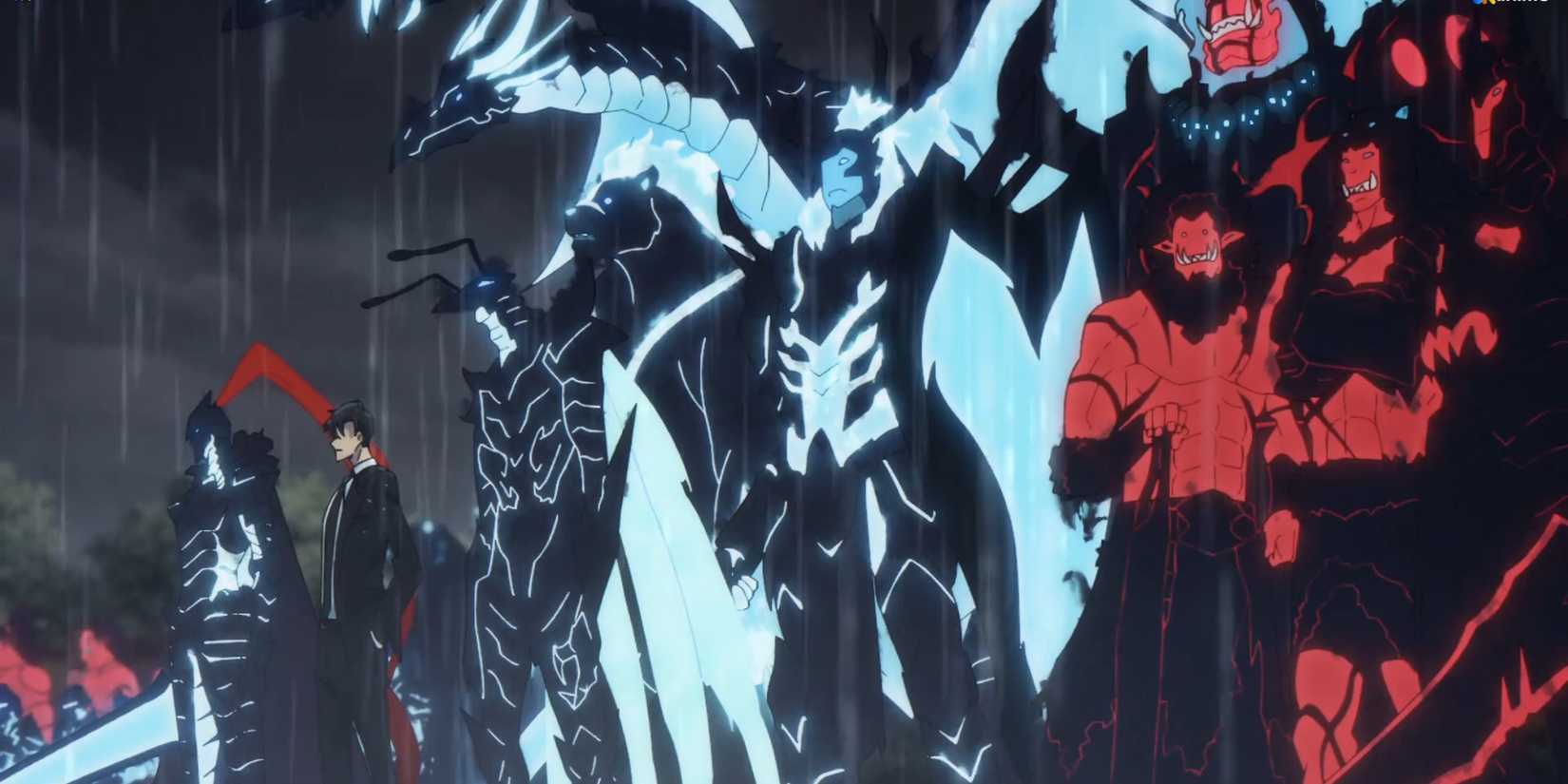
- Arise: The command that raises the dead. Defeated enemies become shadows — soldiers in his personal legion. It’s the single most famous moment in the series for a reason.
Every Major Shadow, Ranked
Jin-Woo’s shadow army is the heart of the show’s spectacle, and each major soldier has a personality worth knowing. Ranked in the order he acquires them:
- Igris — the Blood-Red Commander. The first elite shadow, raised from a knight who nearly killed Jin-Woo. The fan favorite, and the moment the “solo” premise becomes a partnership. His loyalty is absolute and his swordwork is the show’s best.
- Iron. Raised from the body of Kim Chul, a rival hunter who died in the Red Gate incident. A tank who communicates in grunts and enthusiasm — the comic relief of the legion.
- Tank. The ice-bear boss of the Red Gate dungeon. A simple, enormous brawler; proof that not every shadow needs a personality to be fun to watch.
- Tusk. Raised from Kargalgan, the high-orc shaman who ran an entire dungeon hierarchy. A spellcaster with a temper — the legion’s artillery.
- Kaisel. A wyvern raised after the demon castle arc. Jin-Woo’s personal transport, and one of the best “fast travel” reveals in the genre.
- Beru — the Ant King. The Jeju Island arc’s apex predator, and the strongest shadow in the army the moment he’s raised. Where Igris is the loyal knight, Beru is the unhinged attack dog who adores his king. His scenes are the show at its most entertaining.
Minor spoiler note: the web novel’s later arcs introduce Bellion, the original shadow marshal, who outranks everyone above. The anime hasn’t reached him yet.
The Bigger War: Rulers and Monarchs (Spoiler Section)
Skip this section if you’re anime-only and want the reveals clean. Everything below concerns material from the novel’s final arcs, which the anime has not yet adapted.
Behind the gates, Solo Leveling is a war between two ancient factions: the Rulers, who protect worlds from destruction, and the Monarchs, who consume them. Earth sits in the middle of that war, and the System itself turns out to be a recruitment tool — built by the Shadow Monarch, Ashborn, who chose Jin-Woo as his successor. The reveal reframes the entire series: the “leveling” was never random, and the story’s real question becomes whether Jin-Woo can remain himself while inheriting a god’s job.
It’s a divisive final act among fans — some love the scale, others miss the dungeon-crawling — but the emotional throughline holds: a weak man given unlimited power, and asked to stay kind with it.
Where the Anime Stands Right Now
The adaptation so far:
- Season 1 (January–March 2024, 12 episodes): from the double dungeon to the Job Change arc, ending with “Arise” — the moment the series became a phenomenon.
- ReAwakening (late 2024): a compilation film recapping Season 1 with the first two episodes of Season 2 attached as a preview. Optional, but a fun theater experience.
- Season 2 — Arise from the Shadow (January–March 2025, 13 episodes): the Red Gate, the Demon Castle, and the Jeju Island raid — widely considered the arc that made the anime unmissable.
- Season 3: not officially confirmed as of mid-2026. Our dedicated tracker covers the production situation in detail — Solo Leveling Season 3 release date: delay, production status, and realistic expectations. The silence is normal for a series this visually intensive, and A-1 Pictures has not signaled abandonment — but nothing is official until it’s official.
Watch Order, Simply
- Season 1 — non-negotiable. The build-up is the point.
- Season 2 — the payoff, and the best the anime has looked yet.
- ReAwakening — only if you want the recap; skippable for binge-watchers.
- The manhwa — for everything after Season 2, and the complete ending. The novel goes deeper into the final-arc lore if you need it.
Where to Watch
Solo Leveling streams worldwide on Crunchyroll, with simulcast subtitles and an English dub, for both seasons. Availability in specific regions occasionally shifts between services, so the safe rule is: check Crunchyroll first, and your region’s usual anime platforms second.
More Solo Leveling Coverage on BakaBuzz
- 10 Best Anime Like Solo Leveling — the ranked follow-up list for when you finish.
- 18 Best Level-Up Anime Series — the broader genre, ranked.
- 15 Anime With the Best Animation — where Solo Leveling’s production sits among the all-timers.
Frequently Asked Questions
- Is Solo Leveling finished? The web novel and manhwa are complete. The anime has adapted through Season 2 (the Jeju Island arc), with Season 3 not yet officially confirmed.
- Why is Jin-Woo the only one who can level up? In-universe, the System is a tool created by the Shadow Monarch to prepare his successor — Jin-Woo was chosen. Explaining more than that enters spoiler territory covered above.
- Is Solo Leveling a manhwa or a webtoon? A Korean manhwa (published on web platforms), adapted from Chugong’s web novel. The anime is a Japanese production by A-1 Pictures.
- Which is better, the anime or the manhwa? The anime is a faithful, spectacular adaptation and the better starting point. The manhwa is faster and goes further; many fans do both.
- What should I watch after Solo Leveling? Our list of anime like Solo Leveling covers the ten best next steps, ranked.
Solo Leveling’s real legacy is that it made the power fantasy respectable again — proof that a simple premise, executed with total conviction, beats a clever one executed halfway. Jin-Woo starts at the bottom and the show never lets you forget it. That’s why the top feels so earned when he gets there.