



 Mohsin Lag
 Here’s the uncomfortable truth about Junji Ito adaptations, stated early so nobody wastes their time: his best work still lives on the page, and the anime adaptations have a batting average that would embarrass most directors into retirement. But when they hit — and the best of them hit hard — they capture something the manga can’t: motion. The spiral moving. The sound of something wet approaching. Dread as a thing that happens to you in time instead of a panel you turn away from. This list covers every Junji Ito adaptation that matters, ranked honestly, plus the cosmic-horror anime that scratch the same itch when the adaptations let you down.
Why Ito Is So Hard to Adapt
Ito’s horror lives in the moment of realization — a single panel where a character understands what they’re looking at, and so do you. Animation has to stretch that moment across seconds, and most adaptations fill those seconds with cheap motion and worse music, killing the thing that made the manga work. The adaptations that succeed understand the assignment: atmosphere over jump scares, stillness over motion, and the face as the special effect. Fifteen entries below, ranked by how well they understand that.
The Ito Adaptations, Ranked
| # | Anime | What it’s for |
|---|---|---|
| 1 | Uzumaki (2024) | After five years of delays — delays that became their own horror story — the Uzumaki anime finally arrived, and its firs… |
| 2 | Junji Ito Collection (2018) | Twelve episodes adapting Ito’s short stories, with results that range from “acceptable” to “why did they animate it like… |
| 3 | Junji Ito Maniac: Japanese Tales of the Macabre (2023) | The second anthology, better produced than the first, still missing the point in places. The Hanging Balloons episode is… |
| 4 | Gyo (2012) | Walking fish with mechanical legs — Ito’s strangest premise, adapted as an OVA with a budget that shows. The CG is rough… |
| 5 | Tomie (various) | Ito’s most famous creation has never gotten the adaptation she deserves — a series of live-action films of wildly varyin… |
| 6 | Mononoke (2007) | Not Ito, but the closest thing to his spirit in animation. A medicine seller exorcises spirits by understanding their tr… |
| 7 | Mieruko-chan | A girl who can see ghosts pretends she can’t, because acknowledging them makes them stronger. The premise is pure Ito — … |
| 8 | Paranoia Agent | Satoshi Kon’s one TV series, and the best portrait of collective dread in anime. A boy on roller skates attacks stranger… |
| 9 | Another | A classroom cursed by a dead student nobody remembers. The deaths are Final-Destination-adjacent — one per episode, alwa… |
| 10 | Shiki | Vampires arrive in a rural village, and the show takes its time — too much time, some argue — before the horror starts. … |
| 11 | Hell Girl | The premise is an Ito-style curse: send someone to hell at midnight, and you’ll join them when you die. The show’s antho… |
| 12 | Boogiepop Phantom | An urban legend as a psychological state. The show is more confusing than scary in places, but its portrait of a city qu… |
| 13 | Devilman Crybaby | The cosmic-horror endpoint: humanity’s doom as an inevitability, told in ten episodes with no brakes. Not Ito’s style — … |
| 14 | The Summer Hikaru Died | The upcoming adaptation of one of the most acclaimed horror manga of the decade. A boy’s best friend dies and something … |
| 15 | Made in Abyss | Not horror by genre, but the deeper the characters descend, the more the show reveals itself as cosmic dread wearing an … |
| 1 | Uzumaki | Start here. Three volumes, one village, one spiral. It’s Ito’s longest sustained work and the purest expression of his m… |
| 2 | The Enigma of Amigara Fault | The famous short — a mountain with human-shaped holes that fit specific people — and the reason Ito became a meme. Thirt… |
| 3 | Tomie | Ito’s most famous character: a girl who cannot die, and the obsession she inspires in everyone who meets her. The storie… |
| 4 | Gyo | The walking fish are silly. That’s deliberate. Gyo is Ito’s body-horror epic disguised as a B-movie premise, and by the … |
| 5 | Remina | A planet named after a girl heads toward Earth, and humanity does what humanity does — it blames her. Ito’s most pointed… |
| 6 | Sensor | The late-career work that ties the themes together: cosmic dread, the indifference of the universe, and the question of … |
1. Uzumaki (2024)
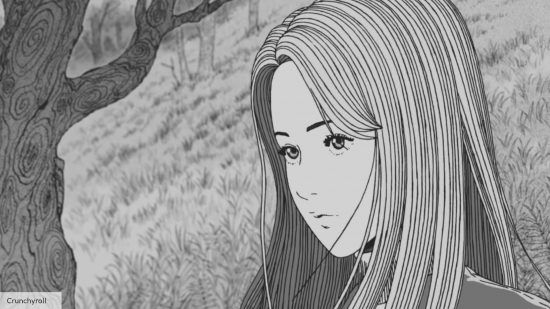
After five years of delays — delays that became their own horror story — the Uzumaki anime finally arrived, and its first episode is the best Junji Ito adaptation ever made. The black-and-white palette, the rotoscope motion, the spiral rendered as a living thing: episode one is a masterpiece. The honest asterisk: the animation quality drops in later episodes as the production collapsed mid-season. Watch episode one as a triumph, and lower your expectations after. The manga remains the definitive version of the spiral.
2. Junji Ito Collection (2018)
Twelve episodes adapting Ito’s short stories, with results that range from “acceptable” to “why did they animate it like that”. The best episodes — Fashion Model, The Long Dream — survive because the source material is bulletproof. It’s a flawed but watchable introduction to Ito’s range. Start here only if you want breadth over depth.
3. Junji Ito Maniac: Japanese Tales of the Macabre (2023)
The second anthology, better produced than the first, still missing the point in places. The Hanging Balloons episode is the standout — the dead-eyed balloons are genuinely wrong in motion, and the sound design earns the dread. The rest is serviceable. The same rule applies: the manga is better, but this one earns a watch for the balloons alone.
4. Gyo (2012)
Walking fish with mechanical legs — Ito’s strangest premise, adapted as an OVA with a budget that shows. The CG is rough, the pacing is odd, but the body horror of the premise survives the cheap production. Watch it for the concept; read the manga for the actual horror.
5. Tomie (various)
Ito’s most famous creation has never gotten the adaptation she deserves — a series of live-action films of wildly varying quality and no definitive anime version. The films are curiosities. Tomie belongs to the page, where her immortality is properly terrifying.
The Cosmic Horror That Scratches the Same Itch
6. Mononoke (2007)
Not Ito, but the closest thing to his spirit in animation. A medicine seller exorcises spirits by understanding their truth, and the art style — textured, theatrical, aggressively beautiful — does what Ito does: makes the supernatural feel ancient and inevitable. The 2024 movie proved the formula still works.
7. Mieruko-chan
A girl who can see ghosts pretends she can’t, because acknowledging them makes them stronger. The premise is pure Ito — the horror of noticing — and the show walks the comedy-horror line better than it has any right to. The ghosts are genuinely unsettling; the denial is genuinely funny. Both halves work.
8. Paranoia Agent
Satoshi Kon’s one TV series, and the best portrait of collective dread in anime. A boy on roller skates attacks strangers, and the city’s panic becomes its own monster. The horror is psychological, spreading — the exact energy of Ito’s spiral, applied to society instead of flesh.
9. Another
A classroom cursed by a dead student nobody remembers. The deaths are Final-Destination-adjacent — one per episode, always inventive — but the atmosphere carries it. The horror is in the class’s slow realization that the curse is real and they’re all complicit.
10. Shiki
Vampires arrive in a rural village, and the show takes its time — too much time, some argue — before the horror starts. When it does, the moral reversal is the point: who’s the monster when both sides are desperate? The slowest burn on this list, and the most philosophical.
11. Hell Girl
The premise is an Ito-style curse: send someone to hell at midnight, and you’ll join them when you die. The show’s anthology format means the horror is the human cruelty that summons the curse, not the curse itself. It runs long, but the best episodes are genuinely haunting.
12. Boogiepop Phantom
An urban legend as a psychological state. The show is more confusing than scary in places, but its portrait of a city quietly losing its mind is pure dread — the feeling that something is wrong everywhere and nobody can name it.
13. Devilman Crybaby
The cosmic-horror endpoint: humanity’s doom as an inevitability, told in ten episodes with no brakes. Not Ito’s style — it’s louder and bloodier — but the existential terror is the same species. The ending sits with you for days. That’s the point.
14. The Summer Hikaru Died
The upcoming adaptation of one of the most acclaimed horror manga of the decade. A boy’s best friend dies and something else comes back wearing his body — and the boy keeps it, because it’s better than losing him. The manga is pure Ito-school dread; the anime is the most anticipated horror adaptation since Uzumaki.
15. Made in Abyss
Not horror by genre, but the deeper the characters descend, the more the show reveals itself as cosmic dread wearing an adventure’s skin. The third arc is one of the hardest watches in anime — the same feeling Ito delivers, earned through beauty instead of gore.
Frequently Asked Questions
Is the Uzumaki anime worth watching?
Episode one, absolutely — it’s the best Ito adaptation ever made. The quality dips after, but the first episode alone justifies the wait.
Which Junji Ito story should I read first?
Uzumaki for the long-form masterpiece, The Enigma of Amigara Fault for the famous short, Tomie for the character. All three are available in English collections.
Why do Ito adaptations keep failing?
Because his horror is static — the frozen moment of realization — and animation has to make it move. The adaptations that lean into atmosphere succeed; the ones that lean into motion fail.
Is The Summer Hikaru Died getting an anime?
An adaptation has been announced and is in production, with 2026 as the expected window. The manga is the way to experience it first.
The Manga Shelf: Ito’s Essential Reading Order
The anime adaptations are a bonus — the manga is the main event. If you’re new to Ito, this is the reading order that builds the dread properly.
1. Uzumaki
Start here. Three volumes, one village, one spiral. It’s Ito’s longest sustained work and the purest expression of his method: take a shape, make it wrong, and let the town rot around it. The final chapters’ answer to “what does the spiral want” is the genre’s most unsettling ending.
2. The Enigma of Amigara Fault
The famous short — a mountain with human-shaped holes that fit specific people — and the reason Ito became a meme. Thirty pages, one panel everyone knows, and the ending still delivers the dread the meme can’t capture. Read it after Uzumaki as a palate cleanser.
3. Tomie
Ito’s most famous character: a girl who cannot die, and the obsession she inspires in everyone who meets her. The stories vary in quality, but the best ones — and there are several masterpieces in the collection — are the genre’s sharpest study of desire as a horror. Read the collected edition.
4. Gyo
The walking fish are silly. That’s deliberate. Gyo is Ito’s body-horror epic disguised as a B-movie premise, and by the ending the silliness has curdled into genuine apocalypse. The manga is far stronger than the OVA adaptation.
5. Remina
A planet named after a girl heads toward Earth, and humanity does what humanity does — it blames her. Ito’s most pointed social horror: the real monster is the mob, and the cosmic doom is almost a relief by comparison.
6. Sensor
The late-career work that ties the themes together: cosmic dread, the indifference of the universe, and the question of what “sanity” means in the face of it. Not his scariest, but his most complete statement. A good place to graduate.
Why Read First, Watch Second?
Ito’s horror is designed for the page — the panel is the unit of dread, and your eye finds the wrong detail a beat before the character does. Animation has to decide what you see and when, which is why even the best adaptation (Uzumaki’s first episode) feels like a cover version. Read the manga, then watch the adaptations as experiments. That’s the order the man himself would approve of.
The Lineage: Directors Who Learned From Ito
Ito didn’t create cosmic dread in manga — but he popularized its shape: the ordinary made wrong, the body as the site of horror, the ending that doesn’t release you. The anime directors below carry that lineage, and their works are the best “if you liked Ito” recommendations outside his own pages.
- Satoshi Kon (Paranoia Agent, Perfect Blue) — the master of psychological dread, where the horror is indistinguishable from the mind experiencing it. Paranoia Agent’s spreading delusion is the closest anime has come to the spiral’s social logic.
- Masaaki Yuasa (Devilman Crybaby, Kaiba) — the master of the body made wrong. His animation physically distorts characters in ways that feel Ito-adjacent: the flesh as a thing that can betray you.
- Shinichiro Watanabe (Cowboy Bebop’s darker episodes) — the jazz noir of dread: horror as atmosphere, creeping in through the edges of otherwise cool stories. The Bebop episode “Pierrot le Fou” is a horror short wearing a bounty-hunter costume.
- Ryūtarō Nakamura (Serial Experiments Lain) — the dread of the digital: the self dissolving into the network. Lain’s slow unwinding is the most “Ito” feeling in anime despite having no monsters at all.
If you finish the Ito manga shelf above and want the same dread in motion, that’s the order to explore: Kon, Yuasa, Watanabe, Nakamura. Four directors who understood that the scariest sentence in horror is “this was always here.”
Why trust this guide: every entry was hand-checked by Mohsin Lag, who has been covering anime and manga for over 20 years. Updated August 2026.
For more horror, see our best horror anime of all time guide and the 2019 hidden gems list.